



On ClickBank, health & fitness (nutra) products currently represent the single largest product category in gross sales on our marketplace!
And the vast majority of ClickBank’s top clients – sellers and affiliates alike – operate in the health & fitness niche today.
I was fortunate enough to interview many of these ClickBank customers over the past few years: nutra media buyer affiliates like Jen LeCompte, Francisco Valenzuela, Izabela Fukano, and Lucas Lino. (Click the link to view all of these incredible ClickBank success stories.)
So, let’s talk about what “health & fitness” means as a niche, and then I’ll share why it’s so profitable for affiliate marketers.
First, here’s the definition for “health & fitness” as we think of it at ClickBank:
Health and fitness: Health encompasses physical, mental, and social well-being, while fitness is the ability to perform daily tasks with energy. Combined, this niche runs the gamut from dietary supplements to exercise training programs to recipe books.
Top Product Types in Health & Fitness
Here are a few examples of popular physical and digital ClickBank health products right now.
These include popular physical consumables (i.e. supplements) like:
- Java Burn for weight loss
- ProstaVive for men’s prostate health
- ProDentim for dental health
- Joint Genesis for joint health
- NewEra Protect for women’s bladder support
And nutra digital programs and info products like:
- The Smoothie Diet (for weight loss)
- The Brain Song (for memory)
- Pelvic Floor Strong (for a strong pelvic floor)
Now, if we just take a quick look at the first page of ClickBank’s marketplace, you can see in just a few listings how diverse the sub-niches and product types are in the health & fitness category.
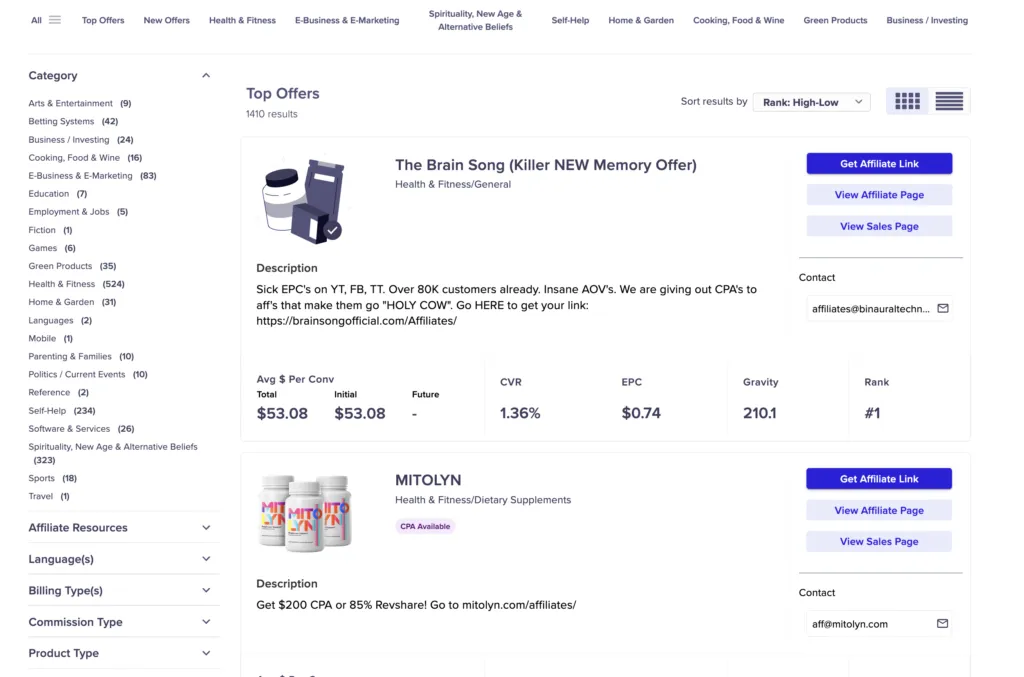
Keep in mind that the top products occupying those spots in the marketplace can and will change over time, but the core principles of success in the health & fitness niche stay the same.
In that vein, we have several great sub-categories of health and fitness products you can drill down into, including:
- Top weight loss affiliate programs
- Best beauty affiliate programs
- Best supplement affiliate programs
- Top dental health affiliate programs
- Top men’s health affiliate programs
- Top women’s health affiliate programs
- Top exercise and fitness programs
- Best sports affiliate programs
Why Health and Fitness?
Now, here are a few of the reasons why the nutra affiliate niche is SO lucrative for both affiliates and sellers:
- High demand: Tackling huge, chronic problems that reach almost everyone on the planet.
- Massive audience ages 40+ (male and female): “Health is wealth,” so older people with more disposable income are both willing and able to spend on health solutions – in other words, they have health problems AND they have money.
- High payouts: The average order value (AOV) is what a customer spends in a single purchase. These days, for health offers, AOVs can top $350, which means MUCH higher potential payouts for affiliates as a % or a flat rate – we’re talking about commissions as high as $200 per sale!
- Wide audience targeting: Broad-friendly for wide targeting on cold traffic channels.
So, we have a massive audience with buying power and high motivation to address their health and fitness problems.
In a nutshell, this is why health and fitness is such an attractive affiliate marketing niche!
Before we move on, let’s highlight a few more details to know about health & fitness:
- Biggest health pain points/sub-niches: weight loss, blood sugar, joints, heart, hearing, vision, respiratory, beauty
- Demographics: M/F ages 40+, more affluent, more liquid cash, established careers or retired
- AOVs are $158 on the low-end and $350+ in many funnels (up substantially from $180-200 AOVs on supplements a few years ago.
- The 1-3-6 bottle supplement funnel has made way for 2, 3, and 6 bottle options, which raises the floor on AOV per sale.
- Strict rules to follow: Regulatory and ad platform requirements around transformation imagery, health claims, and more.
With all that in mind, it’s time to take a look at how ClickBank affiliates should approach this niche if they want to win!
How Affiliates Win in the Health & Fitness Niche: 5 Steps
There are many, many things I could share about the health & fitness niche, but I’ve broken it down to 5 key rules you can’t miss if you want to succeed.
They are:
- Pick the Right Health Offer
- Choose Your Traffic Source
- Define Angles and Hooks
- Scale and Grow
- Build Your Backend
Let’s dive in with step #1.
1) Pick the Right Health Offer
When it comes to picking an offer to promote as an affiliate, remember that the hardest part is already done!
Someone else already came up with the product idea, built the product, crafted marketing messages, set up fulfillment and logistics, and even tested and optimized the funnel – all before you ever showed up to run traffic to their sales page.
That’s a huge advantage. But obviously, not all affiliate offers are created equal, including with nutra offers – so how do you pick the right one?
Well, first of all, ask yourself if the offer appears on one of the first few pages of ClickBank’s marketplace?
If so, then that’s already a note in the product’s favor.
But you still need to do your own due diligence.
Here are the four key metrics you should evaluate for any health offer:
- Average payout – The average payout is how much money in commission you would typically get per sale of the product. Is the average dollar amount per sale high enough to make sense for your marketing efforts?
- Conversion rate – The hop conversion rate measures what % of people go on to the next step, which in this case is making a purchase after viewing a product’s sales page. Is this product converting at or above the industry standard of 1%-2%? The product’s affiliate page will usually state the expected conversion rate.
- Earnings Per Click – Earnings per click is how much money you make per click on your affiliate link for a product. Does this product have an EPC high enough to cover the costs of your promotions (such as cost per click for a paid campaign)? Like with the last metric, the affiliate page will likely show you the EPC of a particular product.
- Gravity score – Gravity score is a unique ClickBank metric reporting on the number of unique affiliates who have made a sale on a product in the last 12 weeks, with higher weight given to more recent sales. A higher Gravity score indicates that many unique affiliates are actively making sales on a particular product.
Evaluating these numbers as they stand currently gives you a good snapshot of how the offer is performing.
But it’s also easy to explore the trend behind these numbers over time by clicking on the product name in the ClickBank marketplace listing.
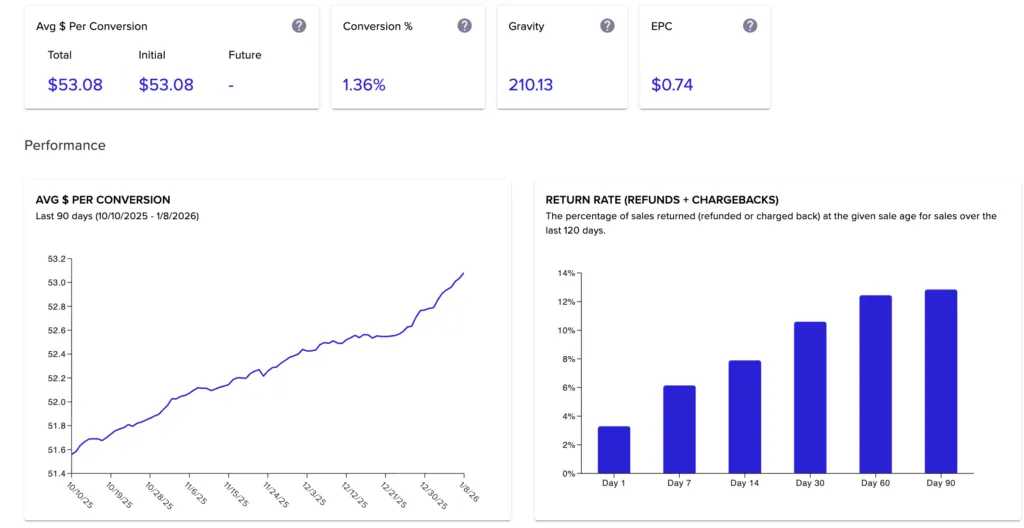
What you want to see is a steady increase in the average payout ($ per conversion) and a flattening or decrease in the refund rate. That indicates that the product is both more optimized and more profitable.
Another factor to look into is the product’s affiliate page (sometimes called the affiliate tools page or affiliate resource page).
You can easily find this on a ClickBank product by clicking the “View Affiliate Page” button on its marketplace listing.
Once you’re there, check out the resources they provide:
- Email swipes
- Demographic data
- Banner images
- Landing page variations
- And more
The more robust this page is, the easier it’ll be for you to stand up your affiliate campaign fast and the more effective you’ll be in promoting this product.
But set aside all the numbers and resources for a minute and ask yourself this: Will the product resonate with your target audience? Can you effectively market this product to them and encourage them to click your ad, go through your tracking link, and make a purchase?
At the end of the day, it all comes down to whether this product is a fit for the people you’re going to market it to.
If it isn’t, then you may want to go back to the drawing board and continue searching for a product that your audience will respond to.
But if it is a good fit, then you’re ready to choose your traffic source!
2) Choose Your Traffic Source
It’s important to understand how direct response health offers work: Most are designed to be sold through a “cold traffic” mechanism.
In other words, you as the affiliate are bringing potential customers to a product and getting them to purchase without them having a prior relationship with that seller or brand.
Under that model, the top paid media channels are Facebook Ads and YouTube Ads. Even with higher costs and some other challenges, these two platforms are still the best places to get in front of lots of health buyers.
Other, smaller channels can work well too, including native ad networks like NewsBreak, TikTok, and other niche ad networks (although it may be best to hold off on running traffic with these platforms until you’re a more advanced affiliate).
Here’s a little about each traffic source and why they work well:
- Facebook: This is a general-purpose platform where people go to visit with their friends, scan the news, engage with interesting content, and basically just scroll. It includes both image-based and video-based content and ads. But most importantly, Facebook has billions of active users around the world, and they allow you to do all kinds of audience targeting in their Ads Manager, from broad to interest-based targeting and even lookalike audiences. There are plenty of ways to dial in who actually sees your ads. Image ads can work on Facebook sometimes, but video hooks still tend to perform best for supplements.
- YouTube: YouTube can be pricey, but it’s even better than Facebook when it comes to “platform congruency.” In other words, your YouTube ads match both the format and intent of the platform, and transition seamlessly into the most common sales page type, which is the video sales letter (VSL). Basically, if they’re on YouTube to watch videos and they see your video ad, watching a well-crafted VSL feels like a natural next step.
- Email: Email sometimes flies under the radar in affiliate marketing, but it’s a powerful secondary traffic source that you can seed with one or more primary traffic sources like paid ads, SEO, or organic social media. In fact, email is currently ClickBank’s #1 channel based on gross sales dollars – that’s actually higher than Facebook Ads. Even affiliates can make use of email if they run paid traffic through an opt-in before pointing leads toward an affiliate product. Don’t sleep on the email marketing route!
- Specialized traffic channels: There are many, many boutique or specialized ad networks and traffic sources out there that you can use as alternatives to Big Tech platforms like Facebook and YouTube. Some popular options include NewsBreak, Snapchat, Rumble, Adskeeper, and a wide range of native advertising platforms like Taboola, RevContent, Outbrain, or MGID. They may be less consistent or proven, but they sometimes woo new users with ad credits. Just be aware that these options can get pricey, so your targeting and messaging should be on point.
Like with the affiliate offer itself, you need to know your audience well enough to determine where they spend their time online.
Quick example: If you had a prostate health offer for men, you wouldn’t choose to promote it to an audience of 18-24 year olds on TikTok.
Facebook is a popular online destination for men and women over 40, which is one reason why Facebook Ads is a great way to promote these types of health products.
Some of it is common sense, but it’s well worth researching the best places to target your ideal audience, especially if you’re spending money on ads or a lot of content.
3) Define Angles and Hooks
Angles and hooks are a key part of what makes direct response offers work. They come at a pain point or problem from a unique vantage point, induce curiosity, and make the ideal audience want to find out more about the solution being offered.
To understand it, I want to dive into the core hook structure.
The Hook Structure
To construct a hook, you need the following three ingredients:
- Pain point
- Unique Mechanism
- Journey or Transformation
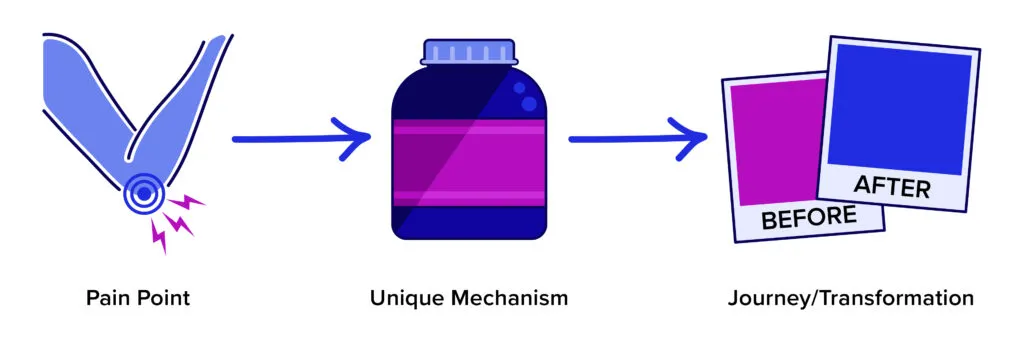
Let’s break that down.
First of all, the pain point: Every quality health offer starts with a pain point that a particular audience really wants to deal with.
One common example is weight loss.
So, a strong hook will take that pain point and then allude to a journey or transformation that takes place to alleviate the pain.
For weight loss, the obvious transformation is losing weight, but it can also include feeling lighter or more energetic, no longer experiencing knee pain in, feeling beautiful again, fitting in a favorite pair of jeans – the list goes on.
No matter what the pain point and journey or transformation looks like, it all stems from something called a unique mechanism.
If you’ve been immersed in the world of direct response for a while, you probably recognize this term, but basically, “unique mechanism” refers to a special differentiator that allows a particular solution to work when other solutions don’t.
For example, with the ClickBank weight loss supplement Mitolyn, the offer had a “purple peel exploit” – this is a powerful, weird-sounding, curiosity-driving unique mechanism that also lends itself super well to eye-catching visuals that can stop the scroll in digital ads.
Another example of a unique mechanism is “Just add this to your morning coffee” (Java Burn).
This is a behavior pattern that’s easy and familiar, but different enough from the everyday routine to be intriguing.
All top health offers on ClickBank lean into some kind of unique mechanism for their product. As an affiliate, your job is to find it and use it in your marketing.
Fortunately, it’s easy to find – it’ll usually be highlighted on their affiliate page, and it should be visible on their pitch page within their text sales letter or their video sales letter script).
How to Create Your Own Hook
When it comes to creating your own angles and hooks for a new round of ad creatives or content, you don’t need to reinvent the wheel.
If you’re already promoting a winning nutra offer, just start by studying their VSL, top creatives, and email swipes. They chose this messaging for a reason – because it works!
Ask yourself: what is the unique mechanism? What pain are they agitating? What transformation are they promising?
Next, make sure there’s congruency:
Align your ad hook with the offer’s core story.
If the VSL leans heavily on a unique ingredient from a special region, such as a purple peel, don’t run a generic “lose weight fast” hook – incorporate THAT angle into your own marketing.
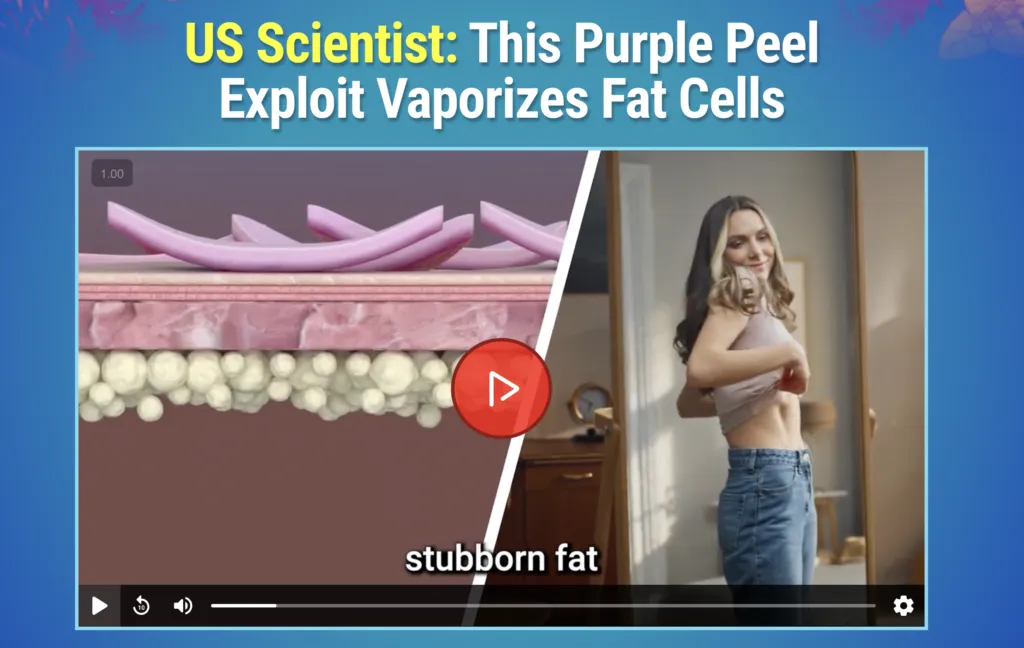
With a great offer and a strong hook on a traffic source that gets you in front of your ideal audience, you’re well on your way to the next step: scale and grow!
4) Scale and Grow
Scaling and growing is the bulk of your actual work as a media buyer affiliate.
Your job is to figure out a combination of affiliate offer + angle/hook + traffic source that consistently generates more in commissions than it costs you in ad spend.
What that means is, most of your daily work is centered around:
- Testing
- Optimization
If the previous step is all about defining angles and hooks, then this step is about making sure that your earlier assumptions were correct.
Get ready to test different iterations across every stage of the funnel: the affiliate offer, the overall angle/hook, the ad copy and creative, and the pre-lander headline/image/body copy.
When you’re at least break-even (for every $1 spent on ads, you earn back $1), that’s when you know there’s potential for scaling profitably. But you want to get up to at least a 1.3X return on ad spend (ROAS), or $1.30 back for every $1 spent, before you scale.
In terms of scaling, there are two main approaches:
- Horizontal scaling: Funneling more spend into new ad sets alongside your current winning ad set. These can be copies of the winner or variations that you expect to perform well.
- Vertical scaling: Funneling more spend into your current winning ad set. Note that you can only ramp it up so much per day – maybe 25% growth at a time.
When you have a winning campaign for a health offer, you should scale it as high as you can and ride it out as long as it’s profitable. There are no guarantees for media buyer affiliates, so you should absolutely make the most of every opportunity to win that you can.
The last thing I’ll say in this stage is the important of cash flow and managing it well.
As a high-volume affiliate, it can help to get paid with a cost-per-action (CPA) commission payout instead of revenue share (RevShare), because you’re not responsible for any refunds – what you’re paid for generating a sale is yours to keep.
Beyond that, the right credit card can make all the difference. Think Chase Sapphire, AMEX Platinum, the Venture X card – all of these let you purchase ads up to an annual maximum of $250K or even no limit.
This allows you to take capital and spread it out.
By no means should you overdo it on ad spend if you’re not profitable, but credit cards like these allow you to scale when you do hit on a winning campaign to keep the momentum going!
Outside of scaling and cash flow, our best advice at this stage is, don’t reinvent the wheel – look for what’s already succeeding out there. There’s a reason the best in the business are doing it the way they are.
5) Build Your Backend
If the front end is all the revenue you receive “up front” when you make a sale from cold traffic through ads, the backend is where revenue really stacks up.
In terms of definitions…
Backend = everything that happens after the first sale or opt-in.
Now, to be honest, this talk of “backend” is a difficult area for affiliates.
A lot of affiliates are attracted to the simplicity of a business model where they run traffic to an offer, take their profits, and either move on or reinvest it back into their campaign.
If you’re just sending raw traffic and never thinking about the backend, then you may:
- Choose offers that don’t monetize well after the first sale. (No rebills or recurring revenue.)
- Miss opportunities to negotiate higher payouts with brands that have strong backend revenue.
You also risk missing out on the flexibility of choosing offers that may not perform well on cold traffic, but crush it via email.
Because in reality, there ARE offers that don’t work as well with front-end cold traffic – but are huge money-makers on email.
Right now, the #1 traffic source on ClickBank is actually email, so it’s not something you want to sleep on.
Now, I get it: you may not be interested in building an email list, growing your own brand, or creating an offer because of the infrastructure required to make those work – but they’re all huge levers you can pull to maximize profitability in the health & fitness niche.
Building your own health offer is a major endeavor and costs a lot of money, but the low-hanging fruit for affiliates is simply growing an email list.
Whether you run paid traffic or focus on organic traffic methods, email gives you the ability to promote more products to the same customer over a longer time span.
How Sellers Build a Health & Fitness Affiliate Program: 4 Insider Tips
This guide is primarily about the affiliate side for health & fitness success, but I did want to share some insider tips for the seller side as well.
These ideas come straight from Kyle Meredith, one of our business development managers who works with many of the Diamond Elite health offer owners on ClickBank (these are people making millions of dollars in sales on platform every year!).
Now, if you see yourself eventually creating your own offer, this section will contain some super helpful information for you! Pay attention.
But even if you’re an affiliate, a rare “behind the scenes” of the offer owner’s experience will help you understand where they’re coming from and become a more effective partner to them.
And now, here are the tips:
Let’s kick off this list with Tip #1!
1) Support Your Affiliates
As an offer owner, if you want to work with top affiliates in this performance affiliate marketing business model, there are a few things to know.
First of all, there are several types of resources you can provide for your affiliates to help them start promoting your offer faster and get sales more easily.
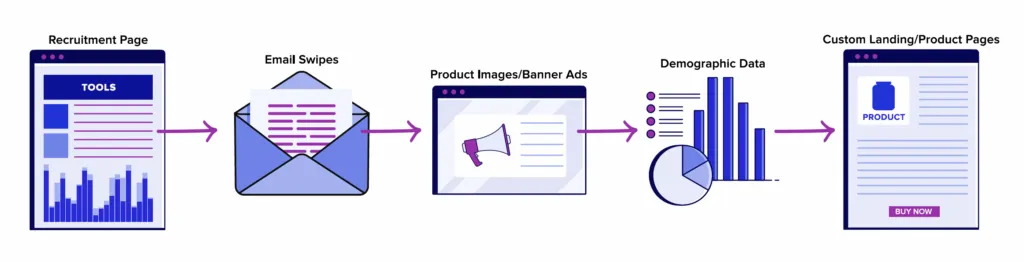
These include:
- A recruitment/tools page
- Email swipes
- Product images and banner ads
- Demographic data
- Custom landing pages
- Attribution or tracking support – hoplink generator, pixels, etc.
You should also note that top affiliates generally prefer the cost per action (CPA) commission structure in order to make money.
In addition, it’s important to get your offer’s metrics into a competitive range with other top ClickBank offers.
You want attractive metrics for your Gravity score, hop conversion rate, average $ per conversion, and earnings per click, as well as your refund rate.
The ideal numbers vary depending on the type of product and your direct competition, but you can always take a peek in the ClickBank marketplace and see what the numbers are for other offers at the top of your product category to see benchmarks.
Last but not least, you should maintain a good relationship with your top affiliates. There’s definitely an 80/20 principle in action when it comes to your affiliates – the top 20% will definitely bring 80% of your sales, at least.
So it’s worth it to support those top affiliates, negotiate payouts with them, and generally make it as easy as possible to promote your products!
2) Improve the Customer Experience
Here’s something you may not always think about: the customer experience can make or break not just your own sales of your product, but your affiliates’ success as well.
The situation is, a negative customer experience directly leads to higher refunds and chargebacks.
On RevShare, affiliates will feel the sting of those refunds as money leaves their ClickBank account – on CPA, they may not see a flat commission that’s attractive enough to justify sticking with your offer.
So, how can you improve customer experience for a health offer?
Here are some ideas:
- The open experience
- Custom packaging
- Custom inserts
- Surprise bonuses
- Enhanced product value
- Nurture sequence
And of course, the most important is that you fulfill and ship orders in a timely manner.
In an age of overnight Amazon deliveries, customers aren’t used to waiting for two weeks for an online order to arrive on their doorstep.
The faster you can get customers their products, the sooner they can start using them.
3) LTV > AOV
Remember this: The brand that can pay the MOST for a customer isn’t just the one with the highest AOV on the initial sale… It’s the one with the highest customer lifetime value (LTV).
And of course, the higher your lifetime value number is, the more money you can offer an affiliate to bring you sales – which means you can attract the BEST affiliates!
Let’s walk through an example to show you what I mean:
Say Brand A has an average order value of $200 on their product, but a lifetime value of $200 as well. That means a customer orders from them once and never again.
Compare that to Brand B, which has an average order value of $150, but a still-modest lifetime value of $300.
In other words, they get an average of one repeat order, which boosts the value of each customer by 100%.
As a result, Brand A can’t afford to pay out an affiliate commission any higher than $200, while Brand B could theoretically pay up to $300 per sale and attract the best affiliates.
The caveat? You need to know your numbers like the back of your hand or you could lose a LOT of money overpaying for new customers!
4) Focus on Profit, Not Revenue
A wise man once said:
“Revenue is a vanity metric. Focus on profit and build a scalable business.”
That wise man, again, is Kyle Meredith.
But the point stands: it’s fun to be able to tell people you made $5 million last year. But if your expenses were $5.2 million, then that’s not so impressive, is it?
And even if you DO turn a profit – say, you made $5 million with expenses of $4.5 million – you want to know that your profit is increasing over time.
That could mean more revenue, but it could also mean focusing on your margins: slashing your cost of goods sold, adjusting your affiliates’ commission rates, upping your prices, or retooling your marketing to boost AOVs and LTV.
The wrong approach is to focus on more and more revenue-generating tasks and just hope that extra revenue means you’re making extra profit too.
Think about it: in the world of affiliate marketing on ClickBank, you could easily get more affiliates with a decent offer if you boost your CPA payout to the top of the heap (say, $200+).
But if you aren’t making $200 on the lifetime value of each customer, then more revenue isn’t helping – you’re actually losing money on every new sale. Not great!
Remember to always bring your focus back to profit, not revenue alone.
Compliance & Platform Rules for the Health & Fitness Niche
In this section, I want to quickly point out a few things about compliance in the health & fitness niche.
FTC and FDA Compliance
For obvious reasons, we all want to live in a society where health and fitness products are safe, effective, and marketed with care not to exaggerate or make unsubstantiated claims.
In the United States, the Food and Drug Administration (FDA) and Federal Trade Commission (FTC) are there to regulate both of the above concerns, respectively.
The most common regulatory issue you’ll run into is the health claim. According to the FDA, health claims suggest that a dietary ingredient may reduce the risk of a disease or health-related condition.
Unlike other permissible claims, health claims require FDA review prior to use.
This applies most to a brand that sells a dietary supplement, but any affiliate who’s promoting a product needs to be aware of this as well.
More specifically, you can’t claim that a certain supplement will diagnose, prevent, treat, or cure any disease unless it’s been approved for that indication by the FDA.
When in doubt, use phrases like “supports,” “aids in,” “intended for,” and “designed to.”
This may be less sexy from a marketing standpoint, but it’s compliant and won’t mislead consumers of any health products you’re promoting.
Major Ad Platform Policies
The next layer of compliance to know about is with the major ad platforms, including Facebook Ads, Google/YouTube Ads, TikTok Ads, and native advertising.
Every platform has its own requirements when it comes to promoting health offers, so be sure you’re up to speed on all of these.
For example, Meta’s Health and Wellness advertising policy covers areas like weight loss, cosmetics, and reproductive health. If you run afoul of these requirements in your campaigns, you may find ads rejected or even get your entire account shut down.
Nobody wants that!
Offer Guidelines for Nutra Affiliates
In addition to following any specific advertising platform policies, affiliates need to abide by any requirements at the affiliate network and offer level as well.
These may be called rules, terms, or guidelines – but the idea is to follow whatever the offer owner requires in order to work with them and promote their product.
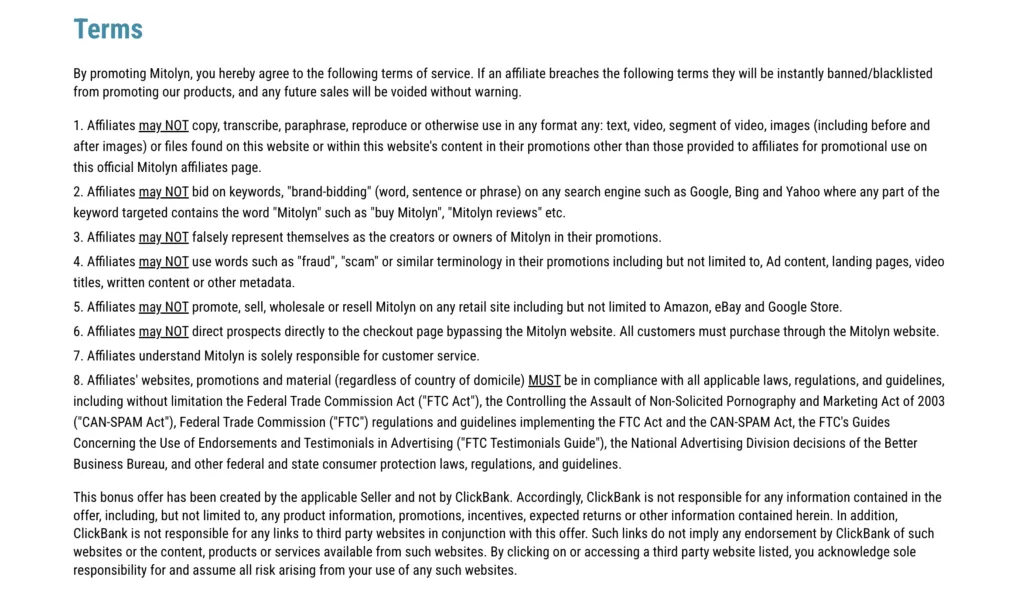
Some offer owners will require whitelisting or approval, and they may also have requests like no brand bidding via paid search, no use of specific traffic sources, or guidelines around the way you conduct your campaigns.
If you choose to promote a specific affiliate health product, it’s important that you know what they need. You can find these on the offer owner’s affiliate page.
Offer Guidelines for Nutra Sellers
As a seller of a health offer, there are things you can do to make sure your offer is in compliance, including with ClickBank or your affiliate network of choice.
That includes reviewing the language you use in your sales letters, product descriptions, pitch pages, and other assets. It may also include submitting a certificate of insurance, custom shipping labels, and so on.
Health and Fitness Affiliate Niche FAQs:
Is health and fitness a good niche for affiliate marketing?
Yes, health and fitness is one of the most profitable affiliate marketing niches, thanks to broad appeal, strong demand, high average order values, and viability with a cold traffic audience. Health and fitness is the #1 niche on ClickBank.
How to make $10,000 per month with affiliate marketing?
If you want to make $10,000 per month in affiliate marketing, you need scale. As an affiliate, you can achieve scale using cold traffic platforms like Facebook Ads, YouTube Ads, and native ads – or through email marketing. As an offer owner or brand, you can achieve scale with affiliates promoting your product for you. Platforms like ClickBank make it easy to list your product and attract top affiliates.
What are popular health & wellness niches?
The most popular and highly profitable health & wellness niches include dietary supplements, diet & weight loss, men’s health, women’s health, beauty, and dental health. Find out more about the top niches in our guide to the top affiliate marketing niches on ClickBank.
Conclusion: Dominating the Nutra Niche
The best way to find success in the health and fitness niche is choosing your own path: affiliate, seller, or both.
Now, while we’ve gone over a lot of the intricacies of the affiliate marketing business model – affiliate and seller – in the health niche, we didn’t really dive into the ways in which you can stand out in a crowded marketplace.
Yes, it’s a lucrative niche, but it’s also competitive. That’s why it’s extremely valuable to have some kind of “unfair advantage” in your corner – whether that’s media buying chops, strong design or video editing skills, copywriting experience, or a health journey story you can share.
Most importantly, you need to understand your audience inside and out – so be sure to choose a niche that aligns with your interests, aptitudes, and experiences.
Okay, if you’ve read this far, what’s your next move?
Well, again, if you haven’t checked out our up-to-date list of top ClickBank supplements, be sure to do that. This can help you find an offer to promote (or a sub-niche you can enter with an offer of your own).
Next, if you’re on the lookout for training on how to generate organic or paid traffic as an affiliate, Spark by ClickBank features quality courses with industry experts who walk you through everything you need to know step by step, all for a low monthly price. Give it a try!
Lastly, I recommend you simply get started. The health & fitness affiliate marketing niche may be intimidating, but it’s a massive opportunity that you don’t want to miss out on.
It’s already made a lot of millionaires – and that will continue. Are you next?
We’ll see you in the ClickBank marketplace!