





ClickBank’s Gravity score is a quick way to gauge an offer’s sales momentum in the ClickBank marketplace. It’s calculated over a 12-week rolling window and reflects the number of unique affiliates who have earned commissions on that offer in that time frame (with greater weight on recent sales).
As an affiliate, use Gravity as a starting signal, but not your final verdict. Higher Gravity can mean stronger proof of conversions, but also more competition.
In this definitive guide, we’ll break down what Gravity measures, how it differs from Rank, and how to use it to evaluate and choose winning offers. Let’s dive in!
What is the ClickBank Gravity Score?
So, first things first: just what exactly is ClickBank’s gravity?
Here’s the official definition from ClickBank:
The ClickBank Gravity Score is a performance metric used to measure the sales momentum of offers on the ClickBank affiliate marketplace. Over a 12-week rolling period, the ClickBank Gravity Score calculates how many unique affiliates are making commissions on a particular offer, with a higher emphasis on more recent product sales.
This number is important for both sellers and affiliates, but in different ways:
For sellers, the ClickBank Gravity Score serves as social proof to attract quality affiliates – it’s evidence that your products not only can get sales, but have gotten sales recently and from many different individuals!
For affiliates, the ClickBank Gravity Score helps uncover promising offers that are actively making commissions for affiliates!
Knowing that both sides depend on gravity in guiding their business decisions, you can be sure that it’s an important factor. We’ll cover how to make decisions based on the score in more detail later in this post!
The History of the Gravity Score
Before we go into some use cases for gravity, here’s a little background on where it comes from.
First of all, the Gravity Score is a metric unique to ClickBank. It utilizes an algorithm that was built to rank offers in a way that is agnostic from revenue.
We wanted a metric that was more helpful, because there are elements that make an offer attractive to affiliates that aren’t solely based on revenue – these include competition, commission rate, and average earnings per sale (also known as average payout value, or APV).
Gravity Score identifies affiliate success with an offer using a numeric value that has no cap!
Two Offers, Two Different Gravity Scores
It can be helpful to see how this works in practice. For example, let’s say there are two products to promote that you’re trying to decide between.
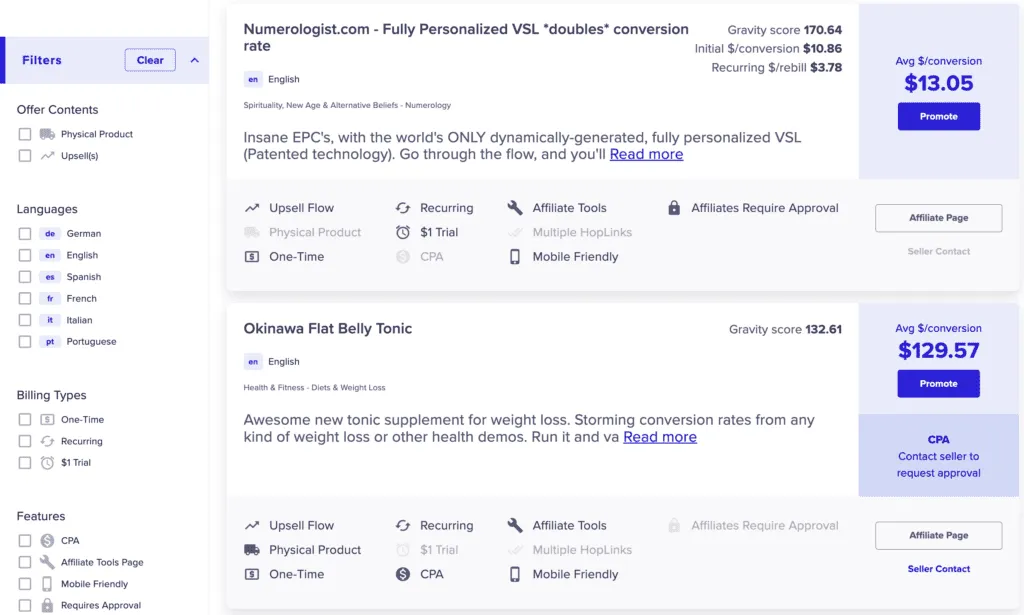
Offer A has a score of 170 and Offer B has a score of 132.
This means that there are more unique affiliates making sales with Offer A than there are unique affiliates promoting Offer B – at least when weighted against how recent the sales were.
This information is helpful to affiliates who are searching for offers because, in theory, they want to promote something that is proven to sell!
However, a high gravity doesn’t mean that an offer is the best choice to promote.
Products with high gravity are likely promoted by many affiliates and competing with affiliates who likely have large ad budgets can be difficult (and discouraging) for affiliates just starting out.
According to Thomas McMahon, the reason these products have lower Gravity Scores truly has to do with one part of the puzzle:
“Why are they so far down in the ClickBank marketplace… on page five with a Gravity Score of 71 compared to 300? Well, it just means that fewer affiliates have picked them up, but they’re still running big volumes because big affiliates have promoted them… it just means they’re less exposed to a big chunk of affiliates, which actually means they might convert better for you because they’ve had less exposure in the overall market.”
Higher Gravity, Higher Competition for Affiliates
Believe it or not, competition is a major concern on both the seller side and affiliate side. That’s why it’s important to keep in mind that the Gravity Score ONLY reflects those affiliates who successfully make a sale!
For example, let’s say an offer with a gravity of 300 had roughly 500 separate affiliates make a commission in the last 12 weeks.
If we’re generous and say that 1 in 5 aspiring affiliates got a sale on this offer, that means another 2000 affiliates tried to promote it and haven’t been able to make a sale yet – but they’re still out there bidding up prices on paid ads and clogging up the organic search results in the meantime!
The gravity score simply can’t account for any of the hundreds or thousands of other affiliates who may have tried and failed to promote that hot new offer – which means your competition is likely a lot higher than you think!
What Goes into the Gravity Calculation?
Gravity score is calculated on a 12-week rolling cycle with more weight placed on recent sales.
“Sales from yesterday count more towards (the score) than sales from last week,” says McMahon.
Scores will start to dip if sales start to lag, but not in real time. This is why products won’t stay at the top forever, but will move down or up the list depending on sales.
If you’re paying attention to products you want to promote, you’ll be able to tell when a product is starting to lose some steam.
Just remember that these numbers aren’t interpreted the same by everyone – one man’s “low” gravity might be another man’s “high” gravity, so to speak. It all depends on your unique approach to affiliate marketing!
Gravity Score vs. Rank
Another thing you may notice if you dive into the ClickBank marketplace filters is an option for Rank. I wanted to point this out because people often get the two confused.
So, what’s the difference between gravity and rank?
With Gravity Score, you’re getting all of those other factors to get a sense of what’s popular, including but not limited to total sales.
With Rank Score, you’re only seeing the volume of sales overall. In other words, products are ranked purely based on total revenue.
Just keep in mind that some top ClickBank products are promoted by the highest-volume affiliates, so just a handful of individual affiliates (or agencies) could be bringing in large dollar amounts with massive ad buys that smaller affiliates can’t keep up with.
A high Rank doesn’t automatically translate into the best results for smaller affiliates – in fact, it’s often just the opposite! Some affiliates use Gravity Score to help them steer clear of the most competitive offers and products.
What is a Good Gravity for ClickBank?
If you’ve read the rest of this post, then you know by now that there IS no “good” Gravity Score, since it’s all arbitrary and relative!
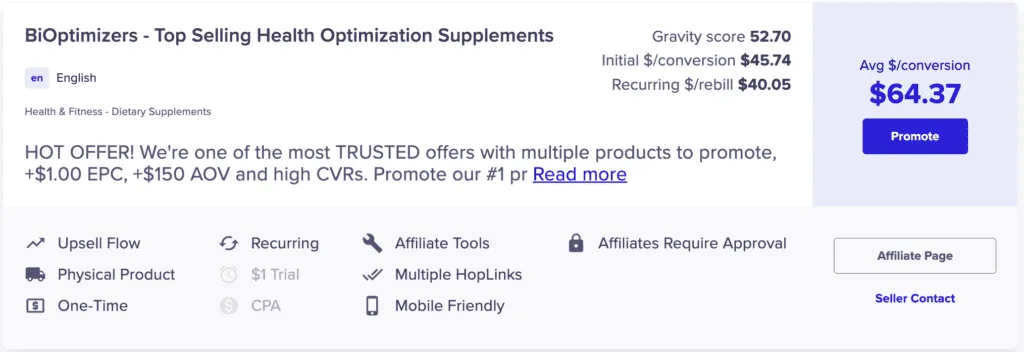
But… If I had to give a number that represents a good gravity for ClickBank, I’d look for an offer with a Gravity Score between 50 and 200.
This range tends to be the sweet spot for many affiliates, where a product is getting enough sales to prove that it can convert, but isn’t so stratospherically high that you’re putting yourself in competition with the largest affiliates.
On the seller side, your first goal is to have a Gravity Score above 0. It gets MUCH easier to bring new affiliates on board once your offer is actively making sales!
Depending on whether you want to scale your offer with big affiliates, however, you may ultimately need to aim for a Gravity Score of 150 and higher.
The most important thing to keep in mind when reading the score is that products from pages 5 through 9 in the ClickBank marketplace are still solid converting products.
A lower score doesn’t mean an offer should be written off from promotion – it only means that an offer above it has more affiliates making sales at the same time!
Selling and Promoting Products with ClickBank Gravity
Ultimately, Gravity Score is just ONE metric of many that you can use to evaluate an offer’s potential as an affiliate. Many of the truly important numbers aren’t based on what a product is doing for anyone else – it’s how it performs for YOU!
That’s why affiliates focus so much on the earnings per click (EPC) metric – as soon as you actively start promoting an offer, you should calculate your EPC to make sure you’re making more money than you’re spending!
If you’re profitable, then the gravity is only relevant in terms of monitoring how much competition you have for the same offer.
Similarly, as a vendor, you’ll find a LOT of other numbers – such as average order value (AOV) and conversion rate – that matter more in getting your products promoted by affiliates.
But the power of social proof is hard to ignore, so don’t neglect the importance of Gravity Score as you scale up your products on ClickBank.
We hope this post has helped you understand more about how gravity is calculated and how to use it as a seller or affiliate.
And for the fastest way to get started with affiliate marketing, check out the ClickBank Start page. Affiliates who take advantage of ClickBank’s affiliate education, resources, and tools are 15.7X more likely to get their first sale, so head over there to get started!
Best of luck and happy scaling!